





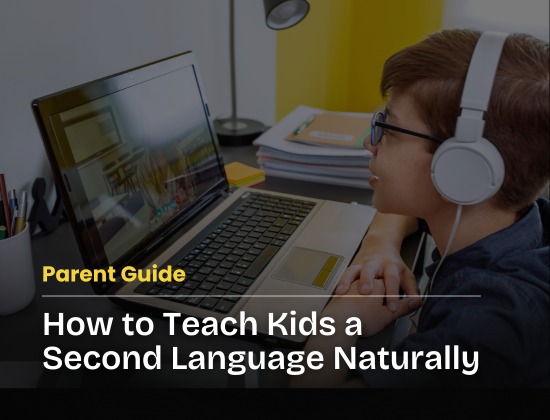
How to Teach Kids a Second Language Naturally | Parent Guide
.
It’s natural for parents to question themselves. Is your child too young? Too restless? Not ready yet? These doubts occur often for parents who wish to nurture bilingualism but aren’t sure where or how to begin this process.
The good news? Children are naturally wired for language. The real challenge isn’t ability but approach.
Research in child development and linguistics consistently showcase that second language learning for kids works best when it feels natural, playful, and pressure-free.
Let’s explore some practical and grounding ways parents can introduce a new language at home and beyond.
1. Start Early, But Don’t Stress About Perfection
A common misconception is that parents need to speak a language fluently to teach it. That simply is a myth. Children learn languages through exposure.
Small, everyday moments make a bigger difference than we realise.Let’s say a song played in the background, a few familiar words, or a bedtime story in another language can slowly build comfort and familiarity along with playfulness in one activity. Research from institutions like Harvard and MIT shows that young children are especially sensitive to sounds and accents, which is why early exposure works even when progress feels slow at first.
2. Make the Language Part of Everyday Life
Avoid forcing the second language during so called “study time” because kids will often resist.
Instead try-
-
Naming objects around the house
-
Using greetings or simple commands in the new language
-
Singing lullabies during sleeptime
This approach replies to the question many parents are confused about: how to teach kids a second language at home without turning it into a chore. When language is part of life, not a lesson, children absorb it naturally.
3. Use Stories, Songs, and Screens Wisely
Picture books, animated shows, and music in the target language provide rich context and emotional connection because children are curious about stories.
Choose content with:
-
Simple, repetitive language
-
Clear visuals
-
Age-appropriate pacing
4. Focus on Listening and Speaking First
Many parents worry when their child doesn’t respond immediately in the new language. This is normal. Children go through a “silent period” where they listen and understand before speaking.
5. Create Positive Emotional Associations
Children learn best when they feel safe and encouraged. Avoid correcting mistakes too often. Instead, model the correct usage naturally.
For example, if your child says a word incorrectly, repeat it back correctly in a sentence calmly. This gentle reinforcement builds confidence in the kids theory but is one of the most overlooked bilingual education tips for parents.
6. Consistency Matters More Than Duration
You don’t need hour-long lessons. What matters is frequency.
Ten to twenty minutes a day every day can be far more effective than a long session once a week. Consistency helps children recognise patterns and retain vocabulary over time.
This is where structured support can help parents stay on track.
7. Leverage Online Foreign Language Courses in India
We figured that sometimes, as a parent, you need a partner in this process. In India, the demand for bilingualism is incredibly soaring, and Online Foreign Language Courses in India have made it easier than ever to find native-speaking tutors.
Platforms like The Language SKOOL offer specialised modules for children. Unlike adult classes that focus on grammar charts, these courses focus on:
-
Interactive Storytelling: Keeping short attention spans engaged.
-
Visual Aids: Using "Total Physical Response" (TPR) where kids move and gesture to mimic words.
-
Peer Interaction: Small group settings where kids can practice with others their age.